Unlocking Design Potential with Islamic Decorative Window Arches with Floral and Vector Details
There is a specific kind of elegance that comes from Islamic architecture, a visual language built on precision, symmetry, and an almost mathematical beauty. When you look at Islamic Decorative Window Arches with Floral motifs and geometric precision, you aren't just seeing a shape; you are seeing centuries of artistic tradition distilled into a single silhouette. For designers, architects, and creatives working today, accessing high-quality vector files of these arches isn't just about saving time—it's about bridging the gap between historical grandeur and modern application.
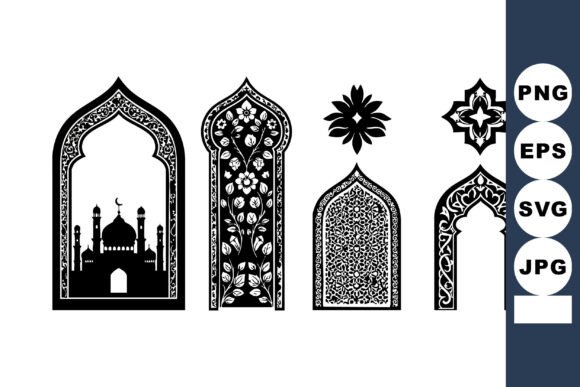
The core appeal of these assets lies in their versatility. We are talking about black silhouette styles that feature intricate floral and geometric patterns. These aren't cluttered or overly busy; they are bold enough to stand out as a focal point yet detailed enough to reward a closer look. Whether you are working on a branding project for a cultural center, designing interior wall decals, or creating digital invitations for a wedding, having a downloadable ZIP containing SVG, EPS, JPG, and PNG files changes the workflow entirely. It moves you from "trying to draw something that looks authentic" to "perfecting the composition."
Real-World Applications Across Industries
The utility of Islamic Decorative Window Arches with Floral elements extends far beyond religious contexts. While they are naturally at home in mosque renovations or Islamic cultural exhibitions, their aesthetic value has permeated various secular industries. Consider the hospitality sector. Boutique hotels and luxury resorts, particularly those in regions like the Middle East, North Africa, or even themed properties in Europe and America, constantly seek ways to evoke a sense of place. Using these vector arches as laser-cut metal screens for room dividers or as etched glass patterns for lobby windows can instantly transform a generic space into one that feels curated and culturally rich.
In the world of graphic design and branding, these silhouettes serve as powerful framing devices. Imagine a packaging design for a premium date brand, an oud perfume, or a line of artisanal teas. Placing the product name within the negative space of a detailed arch creates an immediate association with quality and heritage. Because the files come in vector formats like SVG and EPS, you can scale them from a tiny logo on a business card to a massive billboard without losing a single pixel of that intricate floral detail. This scalability is crucial for brand consistency.
Event planners and wedding designers also find immense value here. The trend toward personalized, culturally significant weddings has skyrocketed. Couples often want to incorporate traditional motifs without making the event feel outdated. A black silhouette arch projected onto a dance floor backdrop, or printed on acrylic for table numbers, offers a modern twist on tradition. The clean lines of the silhouette style ensure that it photographs beautifully, providing a sophisticated background for portraits that doesn't clash with the attire or the lighting.
Why the Vector Format Matters for Professionals
If you have ever tried to upscale a low-resolution JPEG of a complex pattern, you know the frustration of pixelation. That is why the inclusion of SVG and EPS files in the download package is a game-changer. Vector graphics are math-based, meaning they define shapes through points and paths rather than a grid of colored squares. This allows for infinite scalability. You can take the same file used for a website icon and blow it up to wrap an entire building facade, and the curves of the floral patterns will remain crisp and smooth.
Furthermore, vectors offer editability. While the black silhouette style is striking on its own, professional projects often require customization. Maybe your client's brand colors are deep navy and gold instead of black. With an EPS or SVG file, you can easily ungroup the elements in software like Adobe Illustrator or CorelDRAW and change the fill colors, adjust the stroke weights, or even isolate specific geometric components to create a new pattern derivative. This flexibility turns a static image into a dynamic design tool.
However, the package also includes JPG and PNG files, which speaks to practical usability. Not every user is a vector editor. Social media managers, content creators, or small business owners who need a quick graphic for an Instagram story or a website header can drag and drop the PNG (which usually supports transparency) directly into their projects. This dual approach—providing both raw, editable source files and ready-to-use raster images—ensures that the asset serves everyone from the senior art director to the freelance blogger.
Navigating Cultural Sensitivity and Design Integrity
When working with Islamic Decorative Window Arches with Floral and geometric themes, there is an unspoken responsibility to handle the imagery with respect. Islamic art is deeply rooted in the concept of aniconism—the avoidance of depicting sentient beings in religious contexts—which led to the flourishing of calligraphy, geometry, and vegetal motifs (arabesque). When using these designs, understanding this context helps in applying them appropriately.
For instance, using these arches in a respectful manner means avoiding placements that might be considered trivializing or disrespectful. While a silhouette on a coffee cup might be acceptable in some commercial contexts, placing intricate religious-style patterns on flooring where they will be walked upon can be seen as offensive in many cultures. Being aware of these nuances prevents PR nightmares and shows a level of cultural intelligence that clients appreciate.
Additionally, authenticity matters. There is a difference between a generic "Eastern-looking" curve and a true Islamic arch structure, such as the horseshoe, pointed, or multifoil arches. High-quality vector packs distinguish themselves by adhering to these structural truths. The floral patterns shouldn't just be random leaves; they should follow the rhythmic, interlacing logic typical of arabesque design. When you choose a well-researched asset, you save yourself from having to correct structural inaccuracies later, ensuring the final output feels genuine rather than like a caricature.
Technical Considerations for Fabrication and Print
Beyond digital screens, these designs are increasingly popular in physical fabrication. Architects and interior designers often use these silhouves as templates for CNC routing, laser cutting, or waterjet cutting. Materials range from wood and MDF to brass, steel, and stone. Here, the cleanliness of the vector lines is critical. If the paths in the SVG or EPS file are not closed or contain unnecessary anchor points, it can cause machines to stutter or cut incorrectly.
Before sending these files to production, it is wise to inspect the vector paths. Look for "floating" points or overlapping lines that might confuse the cutting software. The benefit of a professional-grade download is that these files are usually optimized for manufacturing, but a quick check never hurts. Also, consider the material limitations. Intricate floral details that look stunning on a screen might be too fragile if cut into thin wood or metal. In such cases, the ability to simplify the vector slightly—removing the tiniest inner details while keeping the overall silhouette intact—becomes a necessary step in the pre-production process.
Lighting is another factor when translating these 2D silhouettes into 3D installations. Backlighting a laser-cut arch panel can create dramatic shadows that mimic the original architectural intent of filtering light in a courtyard. Testing the opacity and spacing of the geometric patterns against your chosen light source can make the difference between a muddy shadow and a sharp, defined pattern.
Finding the Right Balance in Modern Design
The challenge for modern creatives is integrating Islamic Decorative Window Arches with Floral intricacy without overwhelming the contemporary minimalism that dominates current design trends. The black silhouette style helps immensely here. By stripping away color and texture, the design relies purely on form and negative space. This makes it easier to pair with modern typography, clean layouts, and neutral color palettes.
Think of these arches as architectural jewelry. You wouldn't wear every piece of jewelry you own at once; similarly, you don't need to cover every surface with these patterns. Using them as accents—a header on a website, a border on a menu, a feature wall in a reception area—allows the complexity of the design to shine without creating visual noise. The key is restraint. Let the intricate geometry breathe.
Ultimately, having access to a comprehensive library of these vectors empowers you to tell stories. Whether it's the story of a brand's heritage, the cultural identity of a community center, or the romantic narrative of a wedding, these arches provide a visual vocabulary that is both timeless and adaptable. They remind us that in a world of fleeting digital trends, there is enduring power in patterns that have been refined over a thousand years. By leveraging these tools correctly, you aren't just decorating a space or a page; you are connecting your audience to a richer, more textured visual history.